

Why Temple Gate Films Is Making JOHNSTON: An Interview with Rick Balentine


By Maya Bennett, Temple Gate Films Publicist
Interview with Rick Balentine, executive producer and composer of JOHNSTON and co-founder of Temple Gate Films. Edited and condensed for clarity.
Explore Rick’s work: IMDb · Facebook · Rick Balentine Music.

For Rick Balentine, whose fascination with World War II stretched back to childhood drawings of B-17s and Japanese Zero fighters, discovering the story of USS Johnston was startling. Here was a ship, a captain, and a crew whose actions left him wanting to know much more. Soon, that curiosity would become a conversation with his partner, Mark Rickerby, about whether their independent film company could find a way to tell it.
Today, Temple Gate Films and Paralight Films are working together on JOHNSTON. What began as an ambitious film idea has grown into a deeply personal undertaking involving family photographs, survivor accounts, historical research, and the painstaking work of recreating the people who served aboard the ship. I spoke with Rick about that beginning, the responsibility that followed, and what he most looks forward to as the production moves ahead.

Listen to the interview
A late night discovery
Maya: Take us back to the beginning. How did you first discover Johnston’s story?


Rick: I was scrolling through TikTok late one night—doomscrolling, so to speak—and came across a post that basically said, “I can’t believe they haven’t made a movie about this.” I immediately saw that it was about World War II, so I was locked in right away. The post gave a very brief description of Johnston’s story, and I was shocked that I had never heard of it. I hadn’t heard about the Battle of Leyte Gulf in World War II, let alone Johnston’s specific part in that battle. I felt compelled to dive in and start learning.
Maya: When did that curiosity become a decision that Temple Gate Films should make the movie?
Rick: The daunting part was realizing what it would take to make it traditionally. In my view, the amount of money we would need would put it on the scale of a major studio production. We are independent filmmakers. We don’t have those kinds of resources. I talked to Mark and said, “I think we need to make this film, but I think we’re going to have to use AI to make it.”
The most important thing to me was finding a way to get the story out. I felt compelled to tell it. Once we agreed on that direction, we began working toward a dramatized story of Johnston. We still had to ask ourselves whether we could really take on something this immense. But the more we learned, the more important it became to try.
Why Temple Gate Films
Maya: For someone asking “Why you?” what brought you and Mark to this story?

Rick: Mark and I have a deep respect for our military and for our country. We respect our institutions, even recognizing that anything human is going to be imperfect. We love this country. The story of these men—the captain, his leadership team, and the crew—compelled us to figure out a way to make this happen.
Neither Mark nor I has served in the military. I’m a film composer and a producer, and Mark is an excellent screenwriter. But more than that, we are storytellers. We don’t pretend to have lived that experience. What we feel is an honor in being able to tell the stories of extraordinary Americans and what they did for their country. I don’t think we’re special. I do know that we’re willing. And I think that’s what it takes. A willingness to venture past your comfort zone.
“I don’t think we’re special. I do know that we’re willing.” — Rick Balentine
Maya: How did you decide how much of the larger battle to tell?

Rick: As we researched, we learned that Johnston’s story was part of a much larger story. We also looked into what had already been created and whether other filmmakers were telling it. But we decided we couldn’t try to eat the entire elephant. We were immediately drawn to Johnston, and that is where we wanted to focus. If we can successfully tell this story, we may look at other parts of the battle in the future. For this film, our attention is on Johnston and the people aboard her.
Historical context: USS Johnston fought and was lost in the Battle off Samar on October 25, 1944, part of the wider Battle of Leyte Gulf. Naval History and Heritage Command.
The people behind the production
Maya: Who stands behind the “we” when you talk about making JOHNSTON?

Rick: It began with conversations between Mark Rickerby, my partner and head writer of Temple Gate Films, and me, along with input from other members of our team. We knew early on that we needed to use Paralight, a new AI film production system created by Lee Baker, to make the film. Lee brings extensive animation experience. He’s president of Sandman Studios and Paralight Films, and producer of Stan Lee’s Legion of 5. When he heard Johnston’s story, he immediately wanted to be involved. His partner, Sergeant Major Keith Craig, brings substantial studio distribution experience, with work on releases including Disney’s Coco and The Lion King, Marvel’s Black Panther, and Star Wars: The Last Jedi. Keith also came aboard as an executive producer.

The production partnership is Temple Gate Films and Paralight Films. Lee Baker, Keith Craig, Mark Rickerby, and I are all executive producers on JOHNSTON. At this stage, the four of us are personally covering the film’s expenses. Other people are involved in exploring possible financing, but right now we are backing the work ourselves.
Maya: Was there a conversation that changed the scale of what you were trying to accomplish?
Rick: Yes. At first, we were going to make a good film about a powerful story. Then Lee threw down the gauntlet. He said we needed to make it as historically accurate as possible, while leaving room to dramatize conversations and moments the historical record doesn’t capture. He asked what would happen if we could actually use the faces of the people who served aboard the ship—Captain Evans and the other men. My immediate reaction was that it would be phenomenal. Then I realized what that meant.
It wasn’t a light statement. Those people had to be researched and found. We needed photographs, names, and information. That decision turned into an enormous amount of work, and our cast has now grown to more than 150 characters. I took that challenge to heart. It became almost a sacred trust.
“I took that challenge to heart. It became almost a sacred trust.” — Rick Balentine
When history becomes personal
Maya: How did you begin reaching the families?

Rick: I love research, and I began looking for associations and groups connected with Johnston and the people who served aboard her. ChatGPT has been instrumental in helping us with the research process and in creating images as we develop the film. Finding the Johnston and Hoel community on Facebook was a major step. They graciously welcomed me and allowed me to contact people in the group.
Most of the responses have been positive. Families have sent photographs and shared information about their loved ones. Participating families also have agreements that allow them to share in the film’s success if it is financially successful. What began as researching names became communicating with the people who still carry these men’s stories.
Maya: Was there one family or one story that made the responsibility feel personal?

Rick: The answer is all of them. The families have been so gracious and so kind. Even people who declined because of their opposition to AI have been kind in their responses. We respect that. But for us, AI is the way forward with JOHNSTON. It gives us a way to recreate these men’s likenesses from their photographs and, in a sense, put them back aboard their ship. It is painstaking work, and every attempt to get an image right takes time and costs money. But honoring their likenesses is worth that effort and expense.
The photographs, the personal stories, the documents people have sent through the mail—all of those things have affected me. There have been several times when I’ve found myself tearing up. One man mailed us a collection of survivor accounts from Johnston, published in September 1991 as The Fighting and Sinking of the USS Johnston DD557: As Told by Her Crew. Those accounts are one part of a much broader research effort. We have spent an enormous amount of time researching the battle, the ship, and the men who served aboard her, drawing on historical sources, photographs, documents, information shared by families, and conversations with people who know this history. That work reaches into everything from the crew’s individual lives to the ship itself and the uniforms they wore. It isn’t just one conversation. It is the accumulation of all of them: the people, the families, the pictures, and the stories. That is what has made this so personal.
Maya: You also mentioned how watching footage of the wreck affected you. What did that add to your understanding?
Rick: Seeing the ship on the ocean floor brought another level of emotion. I started watching videos about the wreck and listening to Parks Stephenson discuss the damage and his interpretation of what happened to the ship. Hearing those explanations while looking at Johnston was incredibly moving.
Parks also put us in touch with Shane Stephenson, former director of museum collections at the Buffalo Naval Park, who will serve as technical advisor on JOHNSTON. His knowledge of Fletcher-class ships will help us recreate the ship itself. Those connections matter because there is so much we need to understand and get right.
Historical context: Parks Stephenson, executive director of the USS KIDD Veterans Museum, a retired Navy lieutenant commander, and naval historian, contributed research and served as navigator and mission specialist on the 2021 expedition led by Victor Vescovo that positively identified and surveyed Johnston’s main wreck. This followed the discovery of wreckage in 2019. Caladan Oceanic expedition account.
Research and dramatization
Maya: How are you approaching the balance between historical accounts and the demands of a feature film?

Rick: We are trying to ground the story as closely as we can in the history and in the accounts available to us. Mark Rickerby, my partner and head writer at Temple Gate Films, is the detail guy. I put together the six- to ten-page synopsis, and then Mark gets into the nitty-gritty. That is his forte, his gift. Grounding the story means reading, researching the people, and figuring out the details—from who was aboard the ship to what they wore. The survivor accounts and family material have become part of that process.

There are also parts we have to dramatize to make a film. We weren’t there, and we don’t have a record of every conversation or every moment. The goal is to use what we can learn to tell the story responsibly while recognizing that this is a dramatized feature.
Maya: You’ve spoken about expecting close scrutiny of the historical details. How are you approaching that responsibility, from the uniforms to the ship itself?
Rick: We know people will look closely at the details—the uniforms, the ship, and how we portray life aboard her. Getting those things right matters to us, too. That is why we are putting so much work into research and drawing on the knowledge of people who can help us understand those details. We feel honored to tell this story, and we take that responsibility seriously.
Building the ship and bringing the crew aboard
Maya: Looking ahead, what are you most excited to see come together?
Rick: I’m looking forward to seeing the people we have spent so much time creating and recreating actually aboard the ship. So much of our attention has been on the cast. Now we are working through uniforms, medals, and ribbons—what was worn, when it was worn, and when it wasn’t. We are trying to get those details right before moving further into the ship and putting people into the scenes.
The ship itself is a major hurdle. We need to get as close as possible to Johnston’s actual structure and specifications. We don’t need AI to become creative with the ship. We need it to match the references we are using. That is one of the biggest challenges ahead: bringing all those pieces together so we can tell the story.
Maya: Where does the script stand?
Rick: I would say it is about 90 percent complete at this point. We really love Paralight for both its production capabilities and the way it helps us craft the story. For us, its script-formatting tools have been a better fit than Final Draft or other mainstream screenwriting programs. It is a great standalone screenwriting tool, and it integrates seamlessly into our AI filmmaking workflow. That connection is doing a lot of the heavy lifting for us. As we move into production, it will continue to change based on the needs of the story and our ability to tell it. We have done a great deal of the writing work, but the production process will help us see what needs to be refined.
“We really love Paralight for both its production capabilities and the way it helps us craft the story.” — Rick Balentine
The music Rick is waiting to write
Maya: As a composer, is there a part of the production you are especially looking forward to?
Rick: Writing the score. That will probably be my favorite part. I’m looking forward to getting into the music, the sound production, and the immersive sound we want to create. Our ambition is to work with Dolby Atmos so that, during the battle, the audience can experience sound moving around them. That comes much later in the production. There is a lot to accomplish before we reach that stage. But personally, it is the part I’m most looking forward to.

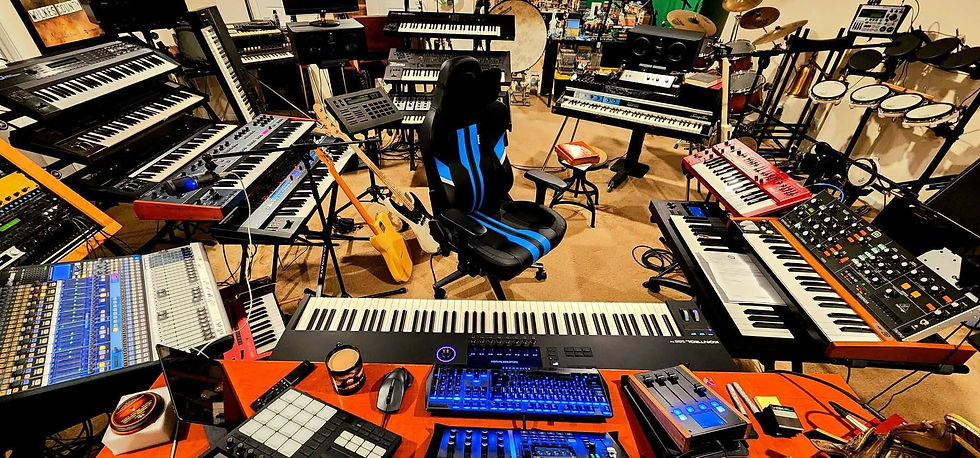
Two views of Rick Balentine’s composing studio.
Maya: And what excites you about the production as a team?
Rick: Testing what Paralight can do. Lee Baker has put an enormous amount of work into it, and we are excited about taking that technology as far as we can with a historical film. JOHNSTON is going to be a real test. We have people, uniforms, a specific ship, and a story we are trying to honor. Pulling those things together is what makes this such an exciting challenge for the team.
A story whose importance does not expire
Maya: Why does telling this story matter now?
Rick: I don’t think the timing is the most important thing. What matters is telling the stories of the best of us—Americans doing extraordinary things to protect our country and our way of life. This is a story of heroes doing what they had to do. That story never gets old. It inspires the best in us.
“That story never gets old. It inspires the best in us.” — Rick Balentine
Whether it had been told twenty years ago or were told twenty years from now, it would carry the same weight. We have the opportunity to tell it, and we are willing to do the work.
A closing reflection from Maya Bennett
What stays with me from this conversation is how far Rick’s willingness now reaches beyond the initial decision to make a movie. It means working through photographs and letters, learning the details of a uniform, listening to families, and facing the practical challenges of recreating a particular ship and her crew. The film is still taking shape. There are technical hurdles ahead, more decisions to make, and music yet to be written. But the reason for undertaking it has become clearer with every story shared.
“I don’t think we’re special. I do know that we’re willing,” Rick says. “And I think that’s what it takes. A willingness to venture past your comfort zone.”
JOHNSTON is in development with Temple Gate Films and Paralight Films.
The JOHNSTON mug
If you’d like a JOHNSTON mug for your own coffee or tea, our 15-ounce ceramic mug is available in the Temple Gate Films store.


What a great interview! Love the knowledge and information you imparted . It just adds to the excitement of this film. All the work the team is putting in is definitely going to pay off with an accurate and important historical event.
Thank you Maya for this. You put a lot of work into this one.